
LuoguP13270 最小表示法
Useful Link
Problem Statement
Reference Blog
Hash Tech: How to compare string with dictionary order
Hash & Binary Lifting find the LCP of two string and then compare the next character.
std::string s, t;int len{0};for (int k{19}; k >= 0; k--) { if (getHash(s, 0, len+(1<<k)-1) == getHash(t, 0, len+(1<<k)-1)) { len += (1 << k); }}if (len == std::min(s.size(), t.size())) ; // s == telse ; // s[len] < t[len]*above code could be wrong
Solution
It’s difficult to solve a problem on circle so copy string behind it.
Now we should solve below problem:
Find hold
Then we consider how to check it quickly. When we are checking the cyclic isomorphism start with and .
- First we find the maximum hold .
- Then compare the character and .
- if is better than , all string start with cannot be answer.
- otherwise, move to .
#include<bits/stdc++.h>using namespace std;const int maxn=2e7;int n;string s;int main() { ios::sync_with_stdio(0); cin.tie(0),cout.tie(0); cin>>n>>s,s=" "+s+s; int st=1; for(int i=2;i<=n;){ int j=0; for(j=0;j<n && s[st+j]==s[i+j];j++); if(j==n) break; if(s[st+j]>s[i+j]){ int m=st; st=i,i=max(i+1,m+j+1); } else i+=j+1; } for(int i=st;i<=st+n-1;i++) cout<<s[i]; return 0;}LuoguP9873 [EC Final 2021] Beautiful String
Useful Link
Problem Statement
Reference Blog
We found that beautiful string is of the form AABCAB, so we can calculate answer by count AB.
Then we can define below two array:
- Let denote, when
AB, the number of substrings equal toABthat start after position . - Let denote, when
AB, the number of substrings beforeABthat are prefixes ofAB.
Then the answer is .
Now consider how to calculate these array.
For , calculate the LCP length of all pair of and then save them in , suffixing f.
For , count the number of LCP of and which length is greater than .
cin >> S;n = S.length(); S = ' ' + S;for(int i = n; i; i--) for(int j = i; j <= n; j++) if(S[i] == S[j]) lcp[i][j] = lcp[i + 1][j + 1] + 1;for(int i = 2; i <= n; i++) for(int j = i + 3; j < n; j++) { int k = min(j - i - 1, lcp[i][j]); if(k >= 2) f[i][k]++; }for(int i = 2; i <= n; i++) for(int j = n - 1; j > 1; j--) f[i][j] += f[i][j + 1];for(int i = 2; i <= n; i++) for(int j = 1; j <= min(i - 1, n - i + 1); j++) if(lcp[i - j][i] >= j) g[i][j]++;for(int i = 1; i <= n; i++) for(int j = 1; j <= n; j++) g[i][j] += g[i][j - 1];long long ans = 0;for(int i = 2; i <= n; i++) for(int j = 2; j <= n; j++) ans += 1ll * f[i][j] * g[i][j - 1];cout << ans << '\n';LuoguP9016 [USACO23JAN] Find and Replace G
These kind of question which after operation can cover early operation we can all consider it from back to front.
We can build a DAG to solve this question. Use examples as demonstrations.
a aba bcc deb bbbBuild 5 nodes for letter a to e, then build graph from last operation.
(7,#,sz=3) / \ (6,#,2) (2,'b') / \(2,'b') (2,'b')Keep the structure of 2-branch tree, but reuse same node.
Below is operator c de:
(8,#,2) / \(4,'d')(5,'e')Then we can see how to combine two subtree (operator a bc):
(9,#,5) / \ (7,#,3) (8,#,2) / \ / \ (6,#) b d e / \ b bFinal version:
(10,#,8) / \ (9,#,5) (7,#,3) / \ / \ (7,#,3) (8,#,2) (6,#) b / \ / \ / \ (6,#) b d e b b / \ b bThen we can get answer from the tree size.
LuoguP7114 [NOIP2020] 字符串匹配
Useful Link
Problem Statement
Reference Blog
It’s a really perfect tutorial. I don’t even know what else to supplement.
We define the -th element of Z-array denote the length of LCP of and .
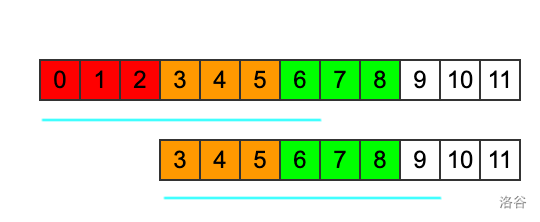
From the image we can know that in problem statement can take any integer from to
is the length of cyclic section. You can understand this expression by the example image. Red part equal to Orange part and Orange part equal to Orange part. Similarly find Red, Orange and Green part are all equal so is the length of cyclic section.
Then we need focus on the number of each letter appear. Classify and discuss the parity of . Define function denote the number of letter wich appear odd times in . Let denote all value selection scheme for , the scheme for to be a odd number should be , for even number should be .
-
When is an odd, we should find the number of which satisfy is denoted as , it will provide contribution.
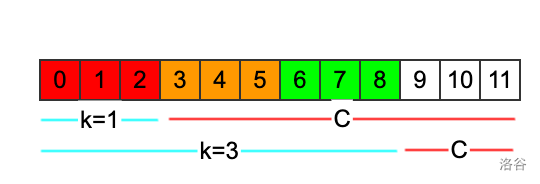
-
When is an even, we should find the number of which satisfy is denoted as , that is because the number of cyclic section is even, even if the letter appear for odd times, it finally turned to even times. So the letter which appear odd time equal to whole string. Answer will increase .
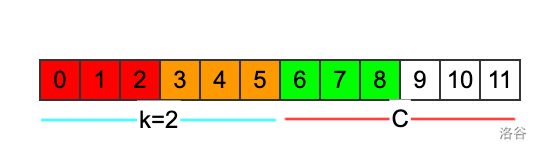
LuoguP3167 [CQOI2014] 通配符匹配
Useful Link
Problem Statement
Reference Blog
OK this problem can protrude the charm of DFS. Most of turorial are using difficult algorithm such as KMP, ACAM but forget the most easy algorithm.
#include<bits/stdc++.h>using namespace std;char ch[100001],wzc[100001];int n;
bool _doudou(int x,int y)// Start brute-force search, search from back to front to avoid some tricky test cases, also makes implementation easier{ if(y==0)// If the pattern string is fully matched { if(x==0)return 1;// If the wildcard string is also fully consumed, then it's definitely correct for(int i=x;i>0;i--)// Check remaining '*' characters if(ch[i]!='*')return 0;// If anything other than '*', then it fails return 1;// Otherwise it's fine }
if(!x)return 0;// If the wildcard string finishes first, then it must fail
if(ch[x]=='*')// If we encounter a '*' { for(int i=y;i>=0;i--)// Try matching from all remaining positions. // The time complexity looks high, but in practice most branches terminate quickly. if(_doudou(x-1,i))return 1; } else { if(wzc[y]==ch[x]||ch[x]=='?') return _doudou(x-1,y-1);// If it's '?', move both strings one position forward else return 0;// Match failed }}
int main(){ scanf("%s%d",ch+1,&n); int len=strlen(ch+1);
while(n--) { scanf("%s",wzc+1);
if(_doudou(len,strlen(wzc+1))) printf("YES\n"); else printf("NO\n"); }
return 0;}LuoguP3082 [USACO13MAR] Necklace G
Useful Link
Problem Statement
Reference Blog
This is a problem which using KMP to optmize DP.
Let denotes, the maximum we can keep when the first -th letter of map the first -th letter of exactly. Then we can get a easy transition
Then we should consider how to calculate quickly. Let denotes when map the first -th letter of exactly and then next letter is . Then we can get below transition.
Coding is easy.